

Research Companion
- Jul 10, 2020
- 13 min read
THE WONDER ATLAS
Research Companion 0044
Come Out to Play
Companion to Wonder Essay 0044


Purpose
This Research Companion accompanies the Wonder Essay Come Out to Play.
The essay began with an ordinary family trip to the cinema and a simple question that quietly followed me home:
How do friendships actually begin?
As I carried that question, I found myself exploring far beyond the original moment. Psychology, neuroscience, child development, sociology, theology and lived experience all became conversation partners. Each offered a different perspective, yet none could fully answer the question on its own.
This Companion gathers together some of the discoveries that helped shape the Wonder Essay. It is not intended to be exhaustive, nor does it seek to replace the beauty of the story with detailed research.
Instead, it offers an invitation to continue exploring.
The questions remain our guide.
The research simply helps illuminate the path a little further.
Introduction
Every Wonder Essay begins with an ordinary moment.
Some readers are content simply to carry the questions that emerge.
Others find themselves wondering where those questions might lead.
This Research Companion is written for those readers.
The accompanying Wonder Essay explored how a simple invitation to play gradually opened into larger questions about friendship, belonging and the quiet ways relationships grow.
Rather than organising the research into separate academic subjects, this Companion follows the same path as the Wonder Observation.
Each question remains the guide.
Psychology, neuroscience, child development, sociology, theology and lived experience become conversation partners. Each contributes something valuable, yet none tells the whole story on its own.
The aim is not to arrive at complete certainty.
It is to see a little more clearly than before.
I hope these pages encourage you to keep asking good questions, paying closer attention and discovering that some of life’s deepest truths often emerge through the most ordinary moments.
So let’s begin where the Wonder Essay began.
With a child’s invitation to play.

Question One
How do friendships actually begin?
Looking back, it seems such a simple question.
Children rarely stop to ask it.
Adults seldom do either.
Friendships simply seem to happen.
Yet the more I carried this question, the more I realised how remarkable that really is.
Some people spend years sitting in the same classroom without becoming close friends.
Others meet while walking a mountain path and feel as though they have known one another for years.
What is happening beneath these ordinary moments?
Research does not point to a single answer.
Instead, it invites us to see friendship from several different perspectives.
Our minds.
Our emotions.
Our bodies.
Our shared experiences.
Our values.
Our willingness to trust.
Each conversation partner helped me see the question a little more clearly.
Psychology
Developmental psychologists have long observed that friendships rarely begin because two people consciously decide to become friends.
More often, they begin because people repeatedly share experiences that create opportunities for trust to grow.
Playing a game.
Working alongside one another.
Walking together.
Learning together.
Facing a challenge together.
Over time these shared experiences become shared memories.
Those memories gradually become the foundation upon which friendship grows.
This helped me understand why so many childhood friendships appeared so naturally.
We were rarely trying to make friends.
We were simply busy sharing adventures.
Neuroscience
Neuroscience helped me notice something I had never really considered before.
Our brains are remarkably responsive to shared experiences.
When people laugh together, cooperate towards a common goal or enjoy positive experiences alongside one another, the brain gradually begins to associate that person with feelings of safety, enjoyment and belonging.
Those repeated experiences make future connection feel easier and more natural.
Friendship is therefore more than an emotional experience.
It is also something our brains are continually learning through ordinary life.
The more we share meaningful experiences, the stronger those connections often become.
Sociology
Sociology added another important perspective.
Friendships rarely grow in isolation.
They usually develop within shared places, shared activities and shared
communities.
A school playground.
A workplace.
A sports club.
A church.
A neighbourhood.
A walking group.
These environments bring people together repeatedly, creating opportunities for trust to develop naturally over time.
Looking back, I realised that almost every close friendship in my own life had begun in exactly this way.
Our attention was directed towards something we shared.
The friendship quietly grew around it.
Theology
As I returned to the accounts of Jesus’ life, I noticed something I had often overlooked.
Much of His teaching happened while people were sharing ordinary life together.
He walked with His disciples.
He ate with them.
He travelled with them.
He attended celebrations.
He sat beside lakes.
He welcomed children.
Again and again, truth seemed to emerge through shared experience rather than formal instruction.
His invitation was wonderfully simple.
“Follow me.”
It was an invitation to walk together before it became an invitation to
understand everything.
That observation gently reshaped the way I thought about friendship.
Relationships often grow, not simply through exchanging ideas, but through sharing life.
Lived Experience
When I looked back over my own life, this pattern appeared almost everywhere.
The friends I climbed hills with.
The colleagues who worked through demanding seasons alongside me.
The conversations that unfolded naturally while walking rather than sitting opposite one another.
The evenings shared around a family table.
Even the friendships that had stood the test of time seemed to have grown quietly through ordinary experiences rather than extraordinary events.
Looking back, I realised that many of the moments I treasure most had not been carefully planned.
They had simply been shared.
What Stayed With Me
Before exploring this question, I assumed friendship grew mainly through conversation.
The more I listened to these different conversation partners, the more that assumption began to change.
Conversation certainly matters.
But it seems to flourish most naturally when it grows from shared experience.
Children appear to understand this instinctively.
They invite one another to play.
Adults often invite one another to talk.
Both matter.
Yet I have become increasingly aware of the quiet power of simply doing ordinary things together.
Walking.
Cooking.
Building.
Serving.
Playing.
The research has not given me a formula for friendship.
Instead, it has given me a deeper appreciation that relationships often grow while our attention is directed towards something we share.
Friendship, it seems, is less something we manufacture and more something we patiently cultivate through the ordinary experiences of life.

Question Two
Why does play help friendship grow?
As the first question settled, another quietly emerged.
If so many friendships begin through play, what is it about play that makes it such fertile ground for relationship?
Children seem to understand something instinctively that adults often overlook.
They rarely play in order to become friends.
Yet friendship often grows while they are playing.
Why?
The more I explored the question, the more I realised that play is doing far more than entertaining us.
It is quietly shaping us.
Psychology
Developmental psychologists have long recognised that play provides one of the safest environments in which relationships can develop.
When people play together, attention shifts away from themselves and towards a shared activity.
That change matters.
Instead of wondering how they are being perceived, people become absorbed in what they are creating, building or enjoying together.
Play also gives us permission to make mistakes.
To laugh.
To improvise.
To recover when things go wrong.
Without realising it, we begin practising many of the qualities that healthy friendships require.
Neuroscience
Neuroscience offers another fascinating perspective.
Enjoyable shared experiences stimulate brain systems associated with connection, learning and positive emotion.
When laughter, movement and cooperation occur together, those experiences become closely linked in our memory.
The brain gradually learns to associate particular people with safety, enjoyment and belonging.
That does not guarantee friendship.
But it creates fertile ground in which friendship can take root and flourish.
Child Development
One of the most beautiful discoveries came from child development.
Children do not separate learning from play.
Play is how they learn.
Through games they discover how to cooperate.
How to negotiate.
How to solve disagreements.
How to include someone who has just joined.
How to recover when things do not go their way.
These are not simply playground skills.
They are life skills.
Friendship quietly grows while these lessons are being learned.
Looking back, I realised that my friends and I thought we were only playing football, riding bikes or building dens.
In reality, we were also learning how to become friends.
Theology
Although the Bible says relatively little about play itself, it says a great deal about joy, celebration and shared life.
Scripture repeatedly presents people gathering around meals, festivals and celebrations.
Life with God is not portrayed as endless duty.
It includes feasting.
Singing.
Hospitality.
Rest.
Delight.
Jesus Himself welcomed children with remarkable warmth.
He attended weddings.
He shared meals.
He celebrated with ordinary people.
That reminded me that joy is not an interruption to life with God.
It is one of the ways His goodness is experienced and shared.
Lived Experience
As I looked back over my own life, I realised that some of my strongest friendships had grown through activities that seemed almost insignificant at the time.
A football in the park.
A day in the hills.
A family board game.
Working on a project together.
Helping someone move house.
None of those moments announced themselves as life-changing.
Yet together they slowly wove relationships that have lasted for years.
The activity often faded into the background.
The friendship remained.
What Stayed With Me
Before exploring this question, I thought of play mainly as something enjoyable.
Now I see it as something deeply formative.
Play creates an environment where trust can grow without being forced.
It lowers barriers.
Invites laughter.
Makes room for mistakes.
Encourages people to share experiences before they share their deepest thoughts.
The more I have carried this question, the more I have found myself valuing play—not as something we outgrow, but as one of God’s quiet gifts for helping people discover one another.
It has also made me wonder whether adults sometimes become so busy organising life that we forget one of the simplest ways friendships have always grown.
Sometimes the invitation we need is still the one children understand so well.
“Do you want to come out to play?”

Question Three
Why does walking make conversation feel easier?
One discovery surprised me more than any other.
Many of the conversations I treasure most have taken place while walking.
Not sitting across a table.
Not maintaining eye contact.
Simply walking the same path.
The more I noticed this pattern, the more curious I became.
Why do some conversations seem to unfold so naturally when our feet are moving?
Research offered several helpful perspectives.
Together, they revealed something I had often experienced without fully understanding.
Psychology
Psychologists have observed that many people find meaningful conversations easier when they happen alongside a shared activity rather than face to face.
Walking changes the dynamics of conversation.
Instead of focusing primarily on one another, attention is gently shared between the conversation and the path ahead.
That subtle shift often reduces self-consciousness.
Silences become less uncomfortable.
Thoughts are given space to emerge rather than being demanded.
For many people, walking creates an environment where conversation feels less pressured and more natural.
Neuroscience
Neuroscience provides another intriguing insight.
Gentle physical movement appears to support clearer thinking, creativity and emotional regulation.
Walking increases blood flow throughout the body, including the brain, while the steady rhythm of movement can help quieten the constant demands of everyday life.
Many people describe arriving at solutions, remembering forgotten experiences or finding words they could not previously express while walking.
The body is moving.
The mind often becomes quieter.
History
For most of human history, walking was simply part of everyday life.
People travelled on foot.
Neighbours visited one another on foot.
Pilgrims journeyed on foot.
Teachers and their students walked together.
Stories were shared along roads, across fields and through villages.
Wisdom was often passed from one generation to the next while travelling together.
Walking was not simply a means of getting somewhere else.
It was one of the places where relationships naturally grew.
Theology
As I returned once again to the Gospels, I began noticing how often important conversations happened while people were travelling together.
Jesus called His first disciples while walking beside the Sea of Galilee.
Much of His teaching took place as He journeyed from one village to another.
Some of His most memorable conversations happened on roads, hillsides and lakeshores.
After His resurrection, two discouraged disciples encountered Him while walking to Emmaus.
As they walked, their confusion gradually gave way to understanding.
The journey itself became part of the transformation.
That observation quietly changed the way I thought about walking.
Walking is rarely just movement.
It creates space.
Space to listen.
Space to notice.
Space to ask questions.
Space for understanding to grow.
Lived Experience
When I looked back over my own life, I realised how many conversations had found their natural home on a footpath.
Walking through the Ochils.
Crossing a Highland ridge.
Following a woodland trail with Mambo.
Strolling beside a loch after a long day.
Some conversations lasted for hours.
Others consisted of only a few sentences.
Both felt complete.
Nobody seemed to mind the silence.
Nobody hurried to fill every pause.
Sometimes the landscape carried the conversation as much as we did.
Looking back, I realised that the path itself had often become a quiet companion.
What Stayed With Me
Before exploring this question, I thought walking simply gave people more time to talk.
Now I see something richer.
Walking changes the environment in which conversation happens.
It softens pressure.
Creates room for silence.
Encourages patience.
Invites honesty without demanding it.
The more I have reflected on this, the more grateful I have become for ordinary walks.
They are rarely just exercise.
They are opportunities to share life at a pace that allows deeper conversations to emerge naturally.
That has given me a renewed appreciation for paths, hills and quiet places.
Not simply because of the scenery they offer.
But because of the friendships they quietly help to grow.
Question Four
Why do ordinary shared moments shape us so deeply?
One of the greatest surprises on this journey was discovering how rarely life’s most important moments announce themselves.
We often imagine that relationships are shaped through dramatic conversations or extraordinary experiences.
Looking back over my own life, I found something quite different.
Many of the moments that have stayed with me seemed wonderfully ordinary at the time.
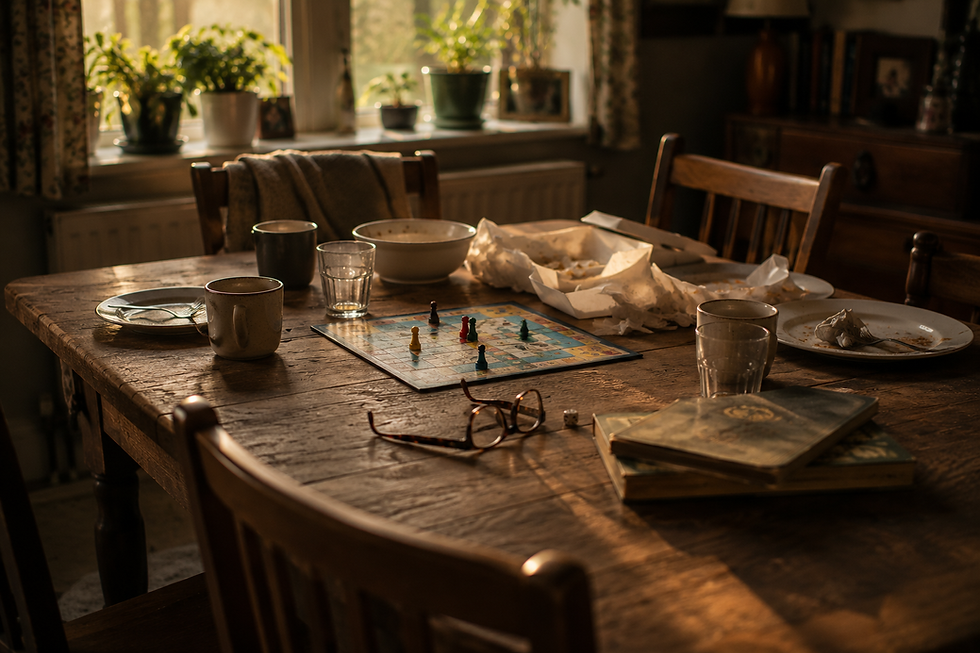
A meal.
A football.
A family trip to the cinema.
A conversation on a hill.
An evening around the table.
None of them appeared remarkable while they were happening.
Yet together they quietly became part of the story of my life.
Why do ordinary moments carry such lasting significance?
Psychology
Psychologists have long recognised that strong relationships are rarely built through one unforgettable event.
Instead, they grow through the steady accumulation of ordinary experiences.
Trust develops gradually.
Shared memories deepen over time.
Reliability strengthens connection.
It is often the repeated moments of kindness, laughter and presence that become the foundation of lasting relationships.
The extraordinary occasionally leaves a powerful impression.
The ordinary quietly shapes a life.
Sociology
Sociology offers another valuable insight.
Communities are not held together by ideas alone.
They are sustained through shared rhythms of life.
Eating together.
Working together.
Celebrating together.
Supporting one another through difficulty.
Across cultures and throughout history, these ordinary practices have created belonging long before people stopped to analyse how belonging was formed.
We do not simply think ourselves into community.
We grow into it by participating in shared life.
Theology
The Bible consistently presents God at work within the ordinary rhythms of human life.
Again and again we encounter meals, journeys, conversations, celebrations, acts of hospitality and everyday work.
Jesus spent remarkably little time separated from ordinary people.
He shared their tables.
Walked their roads.
Visited their homes.
Joined their celebrations.
Comforted them in their grief.
This has encouraged me to see ordinary life differently.
The ordinary is not simply the background against which God occasionally acts.
Very often, it is the place where His quiet work unfolds.
Lived Experience
As I thought about my own family, I realised that many of our happiest memories have not come from elaborate plans or expensive days out.
They have grown from moments that almost passed unnoticed.
Watching a film together.
Sharing fish and chips.
Laughing over something completely unexpected.
Stopping for ice cream on the journey home.
Sitting around the table long after the meal had finished.
At the time, none of those moments seemed especially significant.
Looking back, they have become some of the memories I treasure most.
What Stayed With Me
Before following this question, I naturally gave more attention to life’s obvious milestones.
The more I have explored it, the more aware I am becoming of the quiet importance of ordinary shared moments.
Research has helped me recognise that love is rarely built through isolated acts of significance.
It is woven through ordinary faithfulness.
Showing up.
Sharing life.
Giving attention.
Returning again and again to the people who matter.
This is changing the way I notice everyday life.
I find myself becoming more aware that an ordinary evening with my family is not simply the space between important events.
It is one of the places where life is quietly taking shape.
The more I learn, the more my eyes are being opened to the possibility that many of God’s greatest gifts arrive without announcing themselves.
They simply ask us to be present enough to receive them.
Still Carrying
One of the unexpected gifts of writing this Research Companion has been discovering that good questions rarely disappear.
Some become clearer.
Others become deeper.
Many simply remain.
These are some of the questions I continue to carry.
Why do some shared experiences become lifelong memories while others quietly fade away?
What happens to our capacity for play as we grow older, and how might we recover some of what childhood understood so naturally?
Why do certain landscapes seem to invite deeper conversations than others?
How do ordinary family rhythms shape children in ways that may only become visible many years later?
What other everyday moments are quietly forming us without our noticing?
How might our communities become stronger if we gave greater value to simply sharing ordinary life together?
I no longer see these as questions demanding immediate answers.
They have become companions.
They encourage me to keep paying attention.
To keep observing.
To keep learning.
To keep walking.

Keep Wondering
Thank you for exploring a little further.
If these pages have awakened new questions, don’t feel any pressure to answer them all.
Carry them for a while.
Notice what they help you see.
Read widely.
Listen carefully.
Talk with people whose experiences differ from your own.
Walk.
Play.
Share meals.
Pay attention to ordinary life.
Remain willing to be surprised.
Wonder rarely grows through certainty alone.
It grows wherever curiosity, humility and faithful attention continue to walk together.
The next discovery may already be waiting in a moment that seems too ordinary to notice.
Continue Exploring
The Wonder Atlas Research Companions are intended to be accessible introductions rather than comprehensive studies.
If this Companion has awakened your curiosity, the following resources provide thoughtful opportunities to continue exploring.
Books
Stuart Brown — Play: How It Shapes the Brain, Opens the Imagination, and Invigorates the Soul
A fascinating exploration of why play remains essential throughout life.
Johan Huizinga — Homo Ludens
A classic work examining the role of play in culture and civilisation.
Robert Putnam — Bowling Alone
An influential study of community, social connection and belonging.
John Mark Comer — Practicing the Way
A thoughtful exploration of becoming an apprentice of Jesus through everyday life.
Research Topics
Readers who enjoy exploring further may wish to investigate:
Friendship formation
Developmental psychology
Child development and play
Social neuroscience
Community and belonging
Hospitality
Walking and wellbeing
The role of shared experiences in human flourishing
Biblical Reading
For readers interested in exploring the theological themes further:
Jesus calls His first disciples — Matthew 4:18–22
The road to Emmaus — Luke 24:13–35
Jesus welcomes children — Mark 10:13–16
The early Christian community — Acts 2:42–47
Love one another — John 13:34–35


Comments